Overview
Tears normally drain from the corner of the eye through a small duct into the nose. Blockage of that duct — usually idiopathic, occasionally infective — causes a persistently watery eye and recurrent infections of the tear sac (dacryocystitis).
External DCR (through a skin incision near the nose) gives excellent results but leaves a small scar. Endoscopic DCR achieves the same outcome through the nostril and is now preferred in most cases.
When This Surgery Is Recommended
- Persistent watery eye from a blocked nasolacrimal duct
- Recurrent dacryocystitis or sac abscess
- Failed lacrimal probing or silicone-tube intubation
- Patient preference to avoid an external skin scar
- Bilateral disease where two sides can be done in one session
The Procedure
Done under general anaesthesia, usually with the ophthalmologist working alongside for tear-system access.
- The nasal endoscope identifies the bone overlying the tear sac
- A small window is created in the bone
- The tear sac is opened and stitched to the nasal lining
- A soft silicone tube is sometimes placed to keep the opening patent
- The tube is removed in clinic at 6–8 weeks
Pre-Surgery Preparations
- Pre-op ophthalmology consult and lacrimal probing/imaging
- Continue ophthalmic drops till the morning of surgery unless told otherwise
- Fast 6 hours pre-op
- Stop blood thinners 5 days before with clearance
- Saline rinses started 24 hours before to clean the surgical field
- Companion arranged for transport home
Post-Surgery Recovery
- Same-day or overnight stay
- No facial bandage or external scar
- Saline rinses for 2 weeks; eye drops for 1 week
- Office work in 5–7 days
- Watering improves over 2–4 weeks; full effect by 2–3 months
Follow-up Schedule
- Day 1 — dressing and eye care reviewed before discharge
- Week 1 — nasal endoscopy and silicone stent position check
- Week 6 — silicone stent removed in clinic
- Week 12 — tear-drainage syringing and symptom score
- 6 months — durability check jointly with ophthalmology
Potential Complications
- 85–95% success in published series
- Failure from scarring of the new opening — manageable with revision
- Minor bleeding from the nose
- Temporary mild bruising around the eye in some patients
At Dr. Naseer's ENT, we work this up carefully with the eye team to make sure DCR is the answer your watering eye actually needs.
Why Have It Here
Endoscopic DCR is precision work in a millimetre-scale field with both nasal and ophthalmic landmarks. We work the case up properly first — sometimes the watering has an upstream cause that won't be fixed by surgery alone.
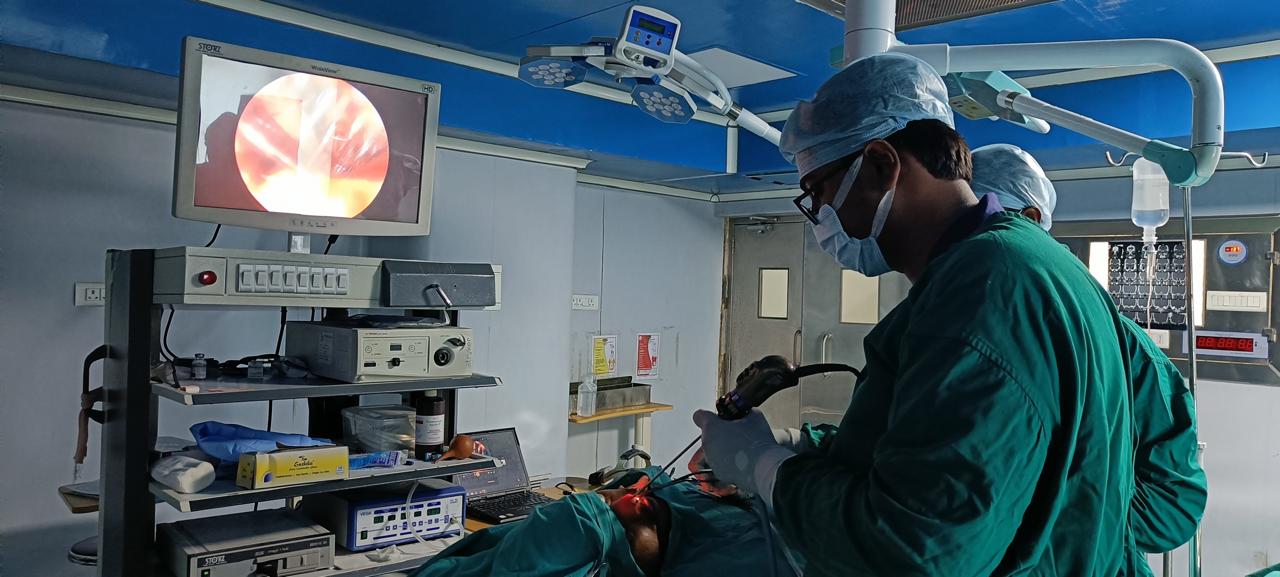 In-house surgical practice · Dr. Naseer's ENT